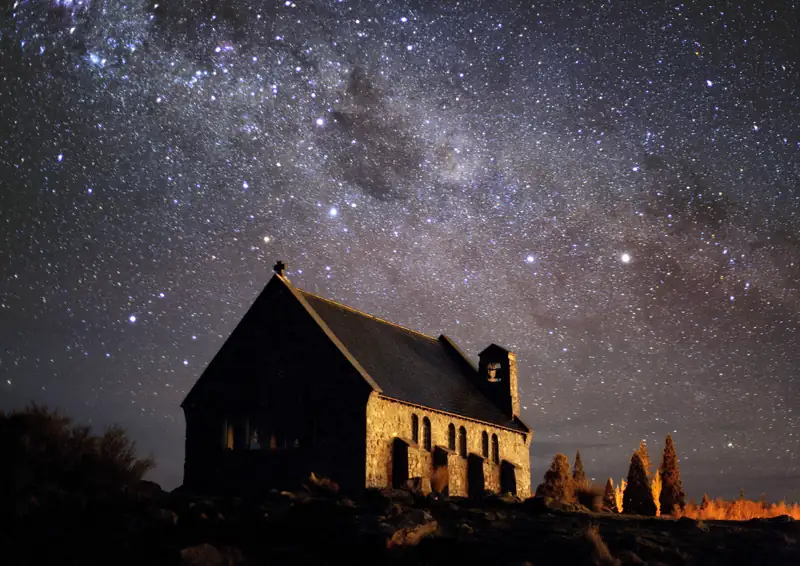
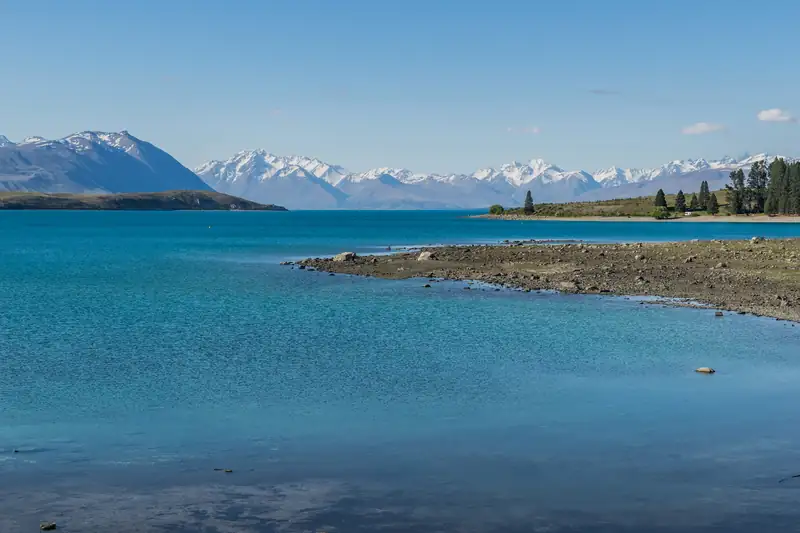
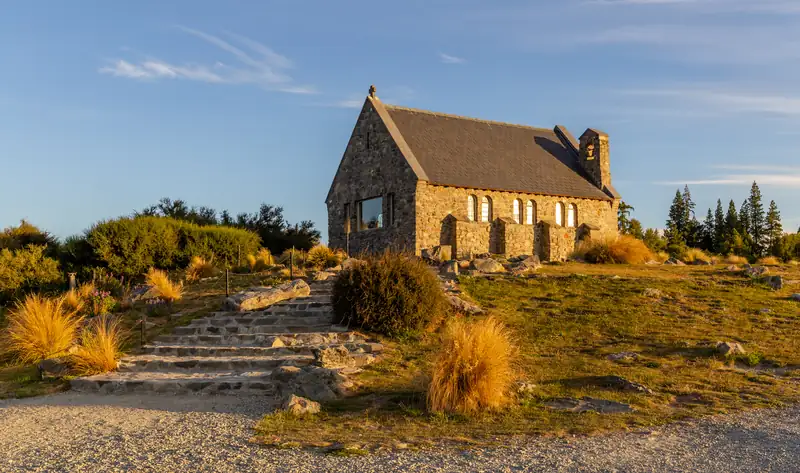
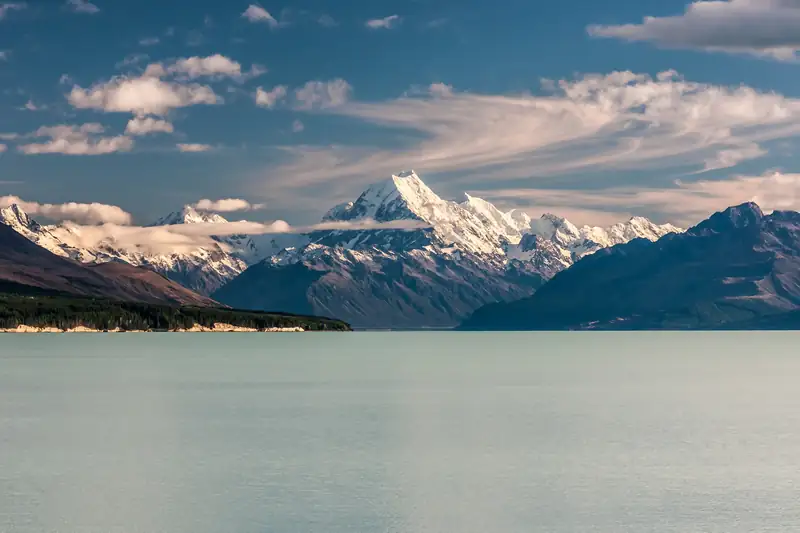
Lake Tekapo is inside the Aoraki Mackenzie International Dark Sky Reserve, set up in 2012, and has guided stargazing every night. Dark Sky Project runs the tour to the University of Canterbury's Mount John Observatory (NZ$239, 1 h 45 min) and a shorter crater tour; Tekapo Stargazing runs telescope and hot-pool tours. Winter usually brings the clearest skies.
Lake Tekapo is one of the easiest places in New Zealand to see a properly dark sky with a guide. The village is inside the Aoraki Mackenzie International Dark Sky Reserve, and several companies run guided evening tours. The best known goes to the summit of Mount John, about 1,029 m up, where the University of Canterbury runs its observatory.
You don’t need a tour to see the stars. But a guide with a 16-inch telescope will show you things you’d never find on your own, and the summit is closed to private cars after dark.
Stargazing tours compared
| Tour |
Operator |
Where |
Length |
Adult price |
Notes |
| Summit Experience |
Dark Sky Project |
Mount John Observatory summit |
1 h 45 min, incl. 15-min bus each way |
NZ$239 (child same) |
Age 10+; 16-inch telescope in a dome; not wheelchair accessible |
| Crater Experience |
Dark Sky Project |
Cowan’s Private Observatory, 5 min drive |
75 min |
NZ$139; child (5 to 17) NZ$99; family NZ$377 |
Age 5+; sheltered crater; wheelchair users follow in their own car |
| Soak in the Stars |
Tekapo Stargazing |
Tekapo Springs |
90 min |
NZ$179; child NZ$115; family NZ$499 |
Telescopes plus a private hot pool, towels and robes |
| Scope at the Stars |
Tekapo Stargazing |
Tekapo Springs |
60 min |
NZ$129; child NZ$84; family NZ$359 |
Telescope tour; includes a daytime hot pools pass |
| Dark Sky Experience |
Dark Sky Project |
Lakefront base, indoors |
45 min |
See operator |
Daytime, all weather, all ages |
Checked November 2026 on the operators’ websites. Dark Sky Project’s prices are valid to 30 September 2027.
Other operators: more Tekapo tours are sold through GetYourGuide, priced there in US dollars. Chameleon Stargazing’s 1.5-hour tour (rated 4.9 from 788 reviews, from US$72) has a 9.25-inch telescope, hot chocolate by a fire bowl and photos of you under the stars. Silver River Stargazing is the cheapest, from US$55 for 75 minutes on a private farm with a 14-inch telescope. Dark Sky Project’s Summit Experience is listed there too. Checked November 2026.
If it’s cloudy: Dark Sky Project moves you to an indoor astronomy session, or offers a new date, a voucher or a refund. Tekapo Stargazing switches to a guided virtual-reality show of the same sky.
Booking: Dark Sky Project takes same-day bookings but says tours are often sold out. If you only have one night in Tekapo, book before you arrive.
The Summit Experience on Mount John
This is the one people mean when they talk about stargazing at Tekapo. You check in at Dark Sky Project’s base at 1 Motuariki Lane, in the village, at least 15 minutes before the start. A bus takes you up to the summit in about 15 minutes. You are lent an extreme cold weather jacket, and the guides start with the naked eye, pointing out constellations with lasers, before moving to telescopes and the observatory dome.
Expect a 100 m walk up a gravel slope and a few steps in the dark. The tour covers Māori astronomy as well as the Western science.
Dark Sky Project grew out of these summit tours. Graeme Murray and Hide Ozawa started them in 2004, after helping install the 1.8 m MOA telescope at the observatory for Nagoya University in Japan; the company says it is the largest telescope in New Zealand. Ngāi Tahu Tourism became a partner in 2016, and the lakefront building opened in 2019.
Mount John Observatory
Mount John rises about 300 m above Lake Tekapo. DOC says the University of Canterbury picked it after site surveys in the early 1960s because it has a high number of clear nights, is far from bright lights, has clear and steady air, and is close to a road and power. Astronomers from Australia, North America, Asia and Europe use it for research.
In daylight the summit is open to everyone. Drive up, park near the Astro Café and walk the Summit Circuit Track in 30 to 45 minutes, or walk up from the village on the Tekapo Mt John Walkway, an 8.9 km loop of about 3 hours that starts next to Tekapo Springs. More on that is on the Lake Tekapo page.
The Aoraki Mackenzie International Dark Sky Reserve
The International Dark-Sky Association approved the reserve in 2012, at the Starlight conference held in Lake Tekapo. It covers Aoraki/Mount Cook National Park and the Mackenzie Basin, and it was the first reserve awarded gold-tier status. Sources give its area as roughly 4,100 to 4,300 km².
It was described as the world’s largest dark sky reserve when it was approved. Today the local operators call it the largest in the Southern Hemisphere; we have not checked how it ranks against reserves approved since.
The reserve works by keeping artificial light down, through advocacy for sustainable lighting across the basin. Aoraki/Mount Cook Village, 1 h 15 min away, is inside the same reserve. DOC says its lighting all points down, and the Hermitage hotel there runs a planetarium and telescope sessions if you are staying at Aoraki / Mount Cook instead.
When to go
- Season: Dark Sky Project says winter often brings the clearest and darkest skies. Every season has something to see.
- Moon: a full moon washes out much of the fainter starlight. For the Milky Way at its best, go near new moon.
- Southern lights: Dark Sky Project lists March to September for the aurora australis. Nobody can promise one.
- Summer: it gets dark late, and tour times follow sunset. If you have children, book an earlier departure.
What to wear
Dress for cold, even in January. The Mount John summit is exposed and windy, and Dark Sky Project warns that wind chill can take it below zero; in winter it often snows. Its packing advice for summer (November to March) is thermals, long trousers, a jersey, a jacket and a hat. For winter (April to October), add a snow jacket, gloves, a scarf, woollen socks and boots that cover the ankle. Don’t wear shoes or clothes that light up.
Stargazing without a tour
On a clear night with no moon, walk away from the lit streets and look up. You’ll see the Milky Way without a telescope. Two things to know: you can’t drive up Mount John after dark, and the grounds of the Church of the Good Shepherd are closed at night. Drones are banned over the village.
For somewhere to sleep after a late tour, see Lake Tekapo accommodation.